
Where snap frames work
Snap poster frames suit spaces where notices, artwork and promotions need to be changed often without removing the frame from the wall. This section explains where they work best and how to choose the right format for your room, corridor, counter area or waiting space.

A practical display option for everyday spaces
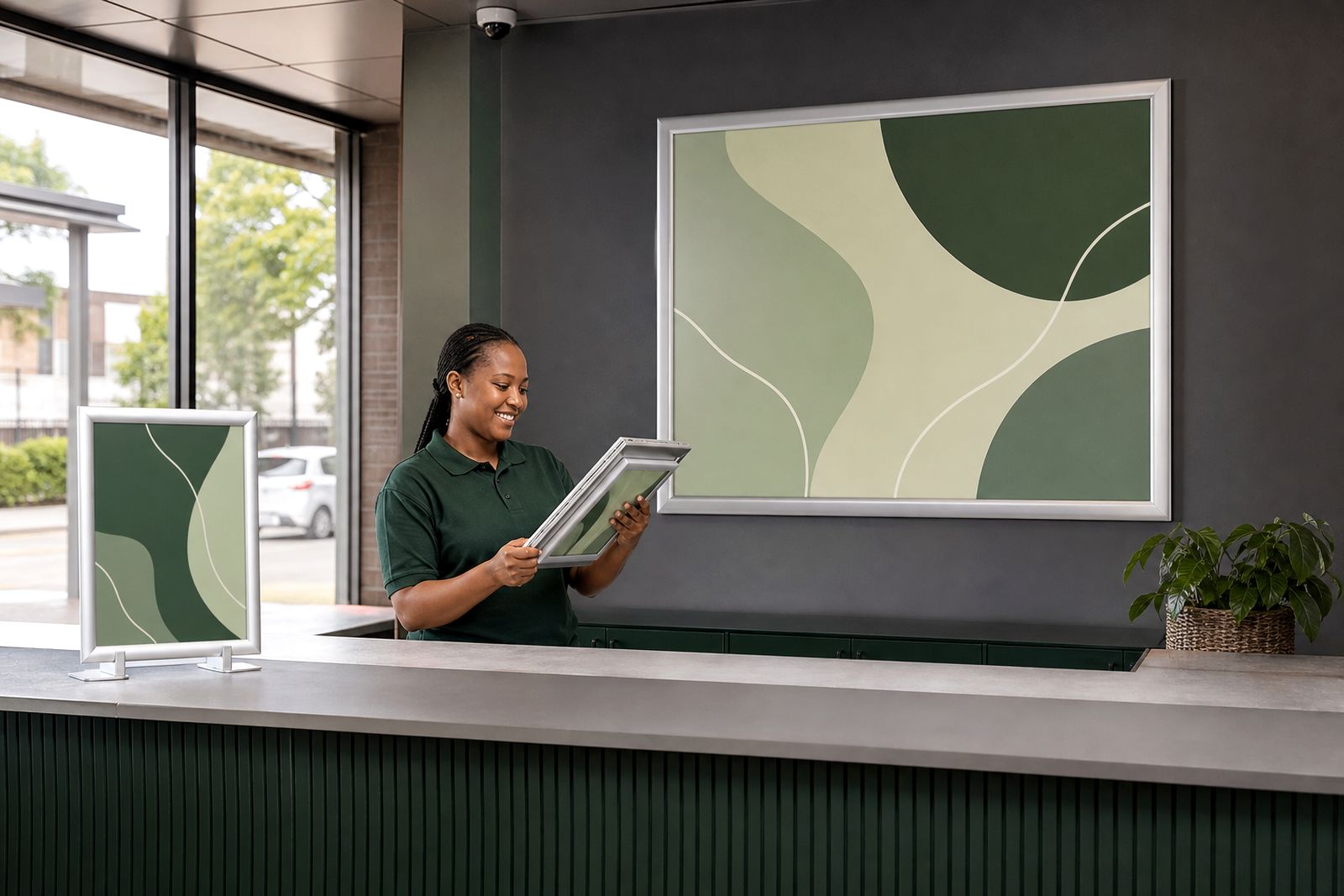
Snap poster frames are made for places where printed messages need to stay neat, visible and easy to update. The front edges open from the front, so you can change a notice, menu, timetable or poster without taking the whole frame down. That saves time in busy spaces and helps keep walls looking tidy.
In Pinetown near Durban we often see the same need across very different settings: a family notice board in a passage, a reception sign in an office, a classroom display, a shop promotion or a clinic information poster. The best choice depends on viewing distance, wall space, indoor or outdoor use, and how often the insert changes. Some sites need a simple wall-mounted frame while others need a hanging frame or a freestanding stand near an entrance.
Where snap frames are commonly used
These frames work well wherever people need to read information clearly and where the insert may change from time to time. They suit both private and public settings, and they fit small prints just as well as large posters.
- Homes: family schedules, house rules, artwork, study reminders and kids room posters.
- Offices: reception notices, room identification, safety signs, internal communication and promotional displays.
- Schools: class notices, event posters, exam timetables, club information and corridor displays.
- Shops: specials, opening hours, directional signs, campaign posters and counter notices.
- Clinics: patient information, queue guidance, hygiene notices and consultation room identification.
Because the frame opens from the front, staff can replace content quickly before opening time or between visitors. That is useful in places with frequent updates, or where a laminated paper pinned to the wall would look untidy after a few weeks.
Choosing by location indoors or outdoors
The first choice is usually whether the frame will be used indoors or outdoors. Indoor spaces give you more freedom on profile finish and mounting position. Outdoor areas need more protection against moisture, wind and dirt, especially in coastal humidity around Durban where paper can ripple if it is not covered properly.
- Indoor frames: best for passages, receptions, classrooms, lounges and consulting rooms.
- Outdoor-rated frames: better for covered entrances, exterior passages and areas exposed to damp air or occasional rain drift.
- Anti-glare covers: useful under bright lights or near windows where reflections make reading harder.
- Wall-mounted options: good where floor space is limited or where the frame must stay in one position.
- Double-sided hanging options: useful when people approach from both directions in a corridor or shop aisle.
- Freestanding stands: suitable for entrance areas, foyers and temporary promotions.
If a frame will sit near an entrance, think about cleaning and durability too. Dust, damp and regular handling can affect how a poster looks over time so the cover and mounting choice matter quite a bit.
How to choose the right size for the viewing distance
Size should match how far away people will stand when reading the poster. A small frame can look neat at close range but becomes hard to read from a few metres away. In a narrow passage an A4 or A3 frame may be enough, while a reception wall or retail window often needs A2, A1 or A0.
As a simple guide, use smaller sizes for close-up reading and larger sizes where people are moving past or reading from across a room. Schools often use mixed sizes, with larger corridor posters and smaller classroom notices. Homes usually lean toward A4, A3 or custom decorative sizes while offices and clinics often need a more standard A-series layout for printed notices.
If your poster is not a standard A-series size, custom options can help you avoid trimming or leaving large blank borders, which can make the display look a bit off.
Quick comparison of the main options
When deciding between frame types it helps to compare them by purpose rather than by appearance alone.
- Wall-mounted frame: best for permanent positions, daily notices and areas with limited floor space.
- Hanging double-sided frame: best for visibility from both sides in walkways, malls or internal corridors.
- Freestanding poster stand: best for temporary messaging, entrances and places where the sign position may change.
- Silver aluminium profile: suits clean, neutral spaces such as offices, schools and clinics.
- Black aluminium profile: suits stronger contrast, retail settings and modern interiors.
- Colour profile: useful where the frame should match a room scheme, school colour or promotional theme.
If the frame is mostly informational, prioritise readability and easy access. If it forms part of a room finish or shop display, profile colour and position may matter more. Most buyers need a balance of both, not just one or the other.
Getting the mounting and layout right
A good frame can still underperform if it is mounted too high, placed in glare, or used in a cramped corner. For homes, eye level in a passage or study area usually works best. In offices and clinics, placement should allow reading without blocking movement at doors or reception counters. In schools, a frame should be reachable for staff but not easily knocked by passing learners.
Fixing kits and spare covers can be useful where frames are updated often or where facilities staff manage multiple display points. It also helps to think about municipal or building rules for shared spaces. Some centres, sectional title complexes and managed office blocks have rules on where notices may be fixed, especially in common passages and entrance areas.
If you are unsure which format suits your space, send your poster size, wall area and whether it is for indoor or outdoor use through the enquiry form on our contact page. We can help you narrow it down quickly.

What our Snap Poster Frames customers say
Verified Google reviews
Questions we get asked
Are snap frames suitable for home use as well as business use?
Yes. They work well in homes for artwork, schedules and kids room posters, and they are also practical for offices, schools, shops and clinics where notices change regularly.
Which is better for a reception area, a wall frame or a stand?
A wall frame is usually better for a fixed notice that stays in one spot. A freestanding stand is better when the message needs to move, such as at an entrance or for a temporary promotion.
Do I need an outdoor-rated frame near a covered entrance?
If the area gets damp air, wind-blown dust or occasional rain drift, an outdoor-rated frame is the safer choice. This is especially useful in coastal areas where humidity can affect paper and covers.
Tell us about the job
Send sizes, materials and where you are through our contact form, and we will come back with the practical options.
Open the contact form